In April 2023, the Special Rapporteur on contemporary forms of slavery called for submissions on the issue of homelessness as a cause and consequence of contemporary form of slavery. The Mercy Foundation was one of many civil society organisations to provide input into the report.
The Special Rapporteur’s report was released in July and can be read here.
The report concludes that homelessness can significantly increase the risk of contemporary forms of slavery, placing persons experiencing homelessness at risk of recruitment and exploitation. Additionally, homelessness can be a consequence of contemporary forms of slavery, as survivors of modern slavery face many barriers in securing affordable, appropriate accommodation.
The report makes a number of recommendations, including
- Enhance the understanding of the linkage between homelessness and contemporary forms of slavery, particularly among relevant public service and law enforcement agencies, ensuring data on the linkage is collected and updated;
- properly identify trafficked and exploited persons experiencing homelessness as victims of contemporary slavery and extend protection without discrimination;
- develop a rights-based approach to preventing and eliminating homelessness, including its causes and consequences;
- regularly evaluate laws and policies on homelessness to test their appropriateness and effectiveness with regard to contemporary forms of slavery;
- prevent and prohibit evictions leading to homelessness
- establish support programs to ensure access to housing for persons leaving out of home care, hospitals, military service or prisons;
- ensure swift access to long term affordable, safe and secure housing to persons experiencing homelessness;
- provide equal access to essential services , including health care and social assistance, as well as access to justice and remedies for all persons experiencing homelessness, without discrimination;
Among the recommendations for civil society organisations, the Special Rapporteur recommends
- enhance the understanding of the linkage between homelessness and contemporary forms of slavery through awareness raising, training, and conduct research and collect data on the linkage regularly,
- the development of a clear and coherent synergy between strategies and measures to eliminate homelessness and contemporary forms of slavery,
- regularly evaluate and report on the State’s efforts to prevent and eliminate homelessness and contemporary forms of slavery.
Congratulations to Mahboba Rawi OAM, who was awarded the Cath Leary Social Justice Award for 2023.
Mahboba Rawi is the founder of Mahboba’s Promise, a charity established in 2001 to improve the lives of vulnerable women and children in Afghanistan and Australia. In 2010, Mahboba was awarded the Order of Australia Medal for service to international humanitarian aid. Read more about Mahboba’s work here.
Last week, Housing for the Aged Action Group (HAAG) released a report Ageing in a housing crisis: Older people’s housing insecurity and homelessness in Australia that reveals the increasing housing insecurity being experienced by older people across the housing system.
In summary:
- The proportion of older people that own their home outright is declining, while the proportion of older people living with a mortgage is increasing.
- There are growing numbers of older people living in private rental.
- Housing affordability in the private rental market is a struggle, with people on the lowest incomes hardest hit.
- Decreasing numbers of older people live in social housing.
- More older people live in marginal housing than they did 5 or 10 years ago. Marginal housing is housing that is overcrowded or in caravan parks.
- The number of older people experiencing homelessness increased by 4,500 over ten years.
- Older men are more likely to be living in boarding houses, compared to older women who are more likely to be living in overcrowded dwellings or staying temporarily with another household.
Recommendations:
Some of the recommendations are:
- Build more public and community housing for people over 55 years who cannot afford rent in the private rental market.
- Strengthen rental laws to enable longer leases and minimum accessibility standards.
- Fund specialist housing support services for older people.
- Financial institutions should work with older mortgage holders to avert financial stress and hardship.
More information and recommendations can be accessed here.
Everybody should read this report: Waithood – the experiences of applying for and waiting for social housing
Across Australia, there are around 175,000 households on the social housing wait list. This report portrays what applying and waiting for social housing is really like for individuals and their families.
The report discusses why people apply for social housing, the challenge of providing the documentation necessary to support a social housing application and the uncertainty of not knowing when housing may become available. It details the precarious living circumstances while waiting for housing, the toll waiting takes on health and wellbeing of both adults and children, the coping strategies people take and their views about the future.
It reminds us that the impacts of homelessness are deeply personal and traumatising. The intense instability created by homelessness impacts heavily on children, creating anxiety, poor sleep and a feeling of being chronically unsettled:
The impacts of waiting are profound. Waitees told of their financial struggles, not being able to feed themselves or their children adequately and cutting back on medication or forgoing necessary medical procedures. Waitees with disability or who were looking after a family member with disability were particularly hard hit by waiting. Many waitees felt that not having an affordable and stable home combined with the endless waiting were fundamental contributors to their poor physical and mental health. Anxiety and depression appeared to be common. Sadly, the children of waitees were often hard-hit by their situation with some having to live away from their parents or in temporary accommodation and having to constantly move.
(page 60)
Our country urgently needs to build more social housing as quickly as possible.
Homelessness should be rare, brief and non-recurring. This week is Homelessness Week and we are joining together to say it’s time to end homelessness.
Homelessness NSW released a report on Monday, called Rare, Brief and Non-Recurring: A System Wide Approach to Ending Homelessness Together. The report highlights the multiple issues and systems that create homelessness. This includes issues such as housing affordability, lack of supply, family and domestic violence, structural issues such as poverty, unemployment, racism, social inequality, justice, health and more.
Solving homelessness isn’t just about more housing, although that is definitely needed. It requires collaboration between multiple stakeholders including all levels of government, government agencies, experts with lived experience, NGO’s, the private sector and community members.
The personal cost of homelessness is devastating for individuals and families. Housing is a human right and all of us are responsible for ensuring everyone in our community has a safe place to call home.
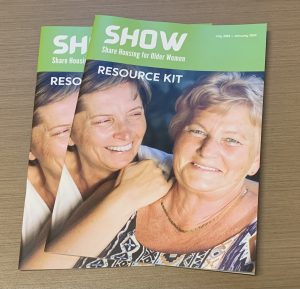
A group of passionate women on the Central Coast came together to address the concerning impacts the housing crisis is having on older women in their community, who are at risk of or experiencing homelessness. The group called themselves AHOW (Action on Housing for Older Women). After consulting with women directly impacted by homelessness, share housing was identified as a possible solution. The group applied for a Grant to End Homelessness to create a model that would make share housing a safe and viable option for women in their community.
After much consultation with real estate agents, social and affordable housing providers and other community groups and organisations, the team developed a model for share housing and a Resource Kit.
The Resource Kit provides information and guides to assist individuals and organisations to develop successful share house arrangements for women over 55 in the private rental sector. The Resource Kit provides information about:
- what is a residential tenancy?
- what is a share house agreement?
- establishing ground rules for share living
- rent assistance and share living
- pros and cons of tenancy options
- support services
The Resource Kit offers the means to develop a Share House Agreement in conjunction with a Residential Tenancy Agreement.
The project team found that while not all women are suited to this model, it does provide a solution for some. The model and resource kit makes this project a replicable model for other communities across Australia.
The SHOW Resource Kit can be downloaded here
Download the SHOW Project Report
A review of Australia’s Modern Slavery Act 2018 (Cth) was released on 25 May. This comprehensive report covered three key questions:
- Can a Modern Slavery Act be effective in combatting modern slavery?
- Could the Act be more effective if changes were made to ow it is framed and administered?
- Is the law being taken seriously?
The review put forward 30 recommendations, including:
- Amending the Act to provide that a reporting entity is an entity that has a consolidated revenue of at least $50 million for the reporting period (currently revenue is $100 million).
- Adding new mandatory reporting criteria that would require an entity to report on:
- modern slavery incidents or risks identified by the entity during the reporting year
- grievance and complaint mechanisms made available by the entity to staff members and other people, and
- internal and external consultation undertaken by the entity during the reporting year on modern slavery risk management.
- The Modern Slavery Act be amended to introduce penalties for specific non-compliance
- Amendments and recommendations for the role and duties of the Anti-Slavery Commissioner and executive administration of the Modern Slavery Act.
The report can be read here.
Walk Free’s Global Slavery Index was released this week, estimating that there are 41,000 people living in modern slavery in Australia. Globally, it’s estimated that 49.6 million people are living in modern slavery. This represents an increase of 10 million people since 2016.
The Global Estimates of Modern Slavery are produced by the International Labour Organization (ILO), Walk Free, and the International Organization for Migration (IOM).
Of the 50 million people living in modern slavery,
- 28 million are in forced labour
- 22 million in forced marriage
- 12 million are children
Modern slavery refers to a situation of exploitation where a person is not free to leave because of threats, violence, coercion or deception.
The report states that modern slavery is driven by conflict, climate change, gender inequality and COVID-19. It also discusses how well governments are responding to modern slavery.
The report notes that the 5 products at risk of modern slavery in Australia are:
- electronics
- garments
- solar panels
- textiles
- fish
It is estimated that US$17.4 billion of imports into Australia are at risk of slavery in their supply chains.
Read more about the Global Slavery Index here
The State of the Nation’s Housing Report 2022-2023 was released by NHFIC Research in April.
Key findings:
- Strong demand for housing coupled with tight supply of both labour and materials, and bad weather has put significant pressure on the construction industry. Approximately 28,000 dwellings were delayed in 2022. NHFIC’s industry consultation suggests builders are making cost allowances of up to 40% for unexpected delays, up from a more normal 20%.
- In addition to higher interest rates, supply of new housing continues to be impeded by a range of factors including, the availability of serviced land, higher construction costs, ongoing community opposition to development and long lead times for delivering new supply.
- Rental growth and rental affordability varied significantly across and within greater city and regional areas, with rental growth in regional areas now falling after a period of record demand. Rental growth in major cities such as Sydney and Melbourne are outpacing rental growth in regional NSW and Vic, which suggests the premium of living in large cities close to employment centres may be returning.
- Rental affordability has varied greatly across the country during COVID-19. In Sydney, rents in several outer Local Government Areas (LGAs) increased more than 30% from early-2020 to January 2023 and more than 3 times that of some inner-city LGAs. Outcomes in Melbourne have been more subdued, with more than half of Melbourne’s LGAs experiencing rental increases of less than 10% since pre-pandemic. Southeast Qld has had the largest rental rises, with all 12 LGAs experiencing rental increases of 30% or more.
- Trends in the macroeconomy can affect the ability of first home buyers to enter the market. Analysis shows that since the 1990s in Sydney, deposit hurdle rates (i.e. deposit as a percentage of income) on average increased by around 8% during an interest rate tightening cycle (-10% so far this cycle), compared with 26% during easing cycles. The average deposit required as a percentage of annual income has nearly doubled over this period from 60% to 110%.
NHFIC estimates that, conservatively, around 377,600 households are in housing need, comprising 331,000 households in rental stress and 46,500 households experiencing homelessness. Housing need across the country range from 208,200 households in highly acute rental stress to 577,400 households under less acute rental pressure.
Read the full report here.


